
High Blood Pressure and the Heart
Updated: Mar 19
What Is High Blood Pressure?
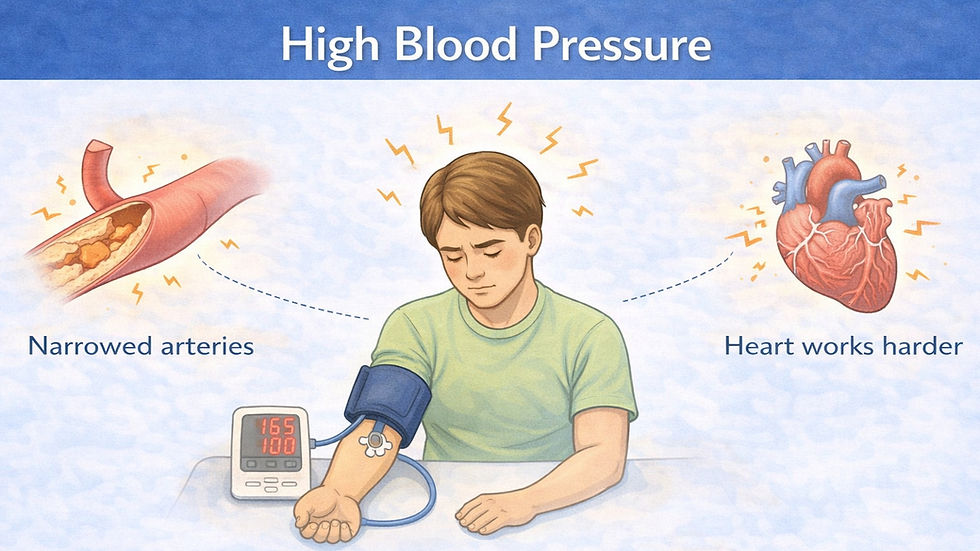
High blood pressure, also known as hypertension, happens when the force with which your blood pushes against the walls of your blood vessels is too high [1]. Hypertension can affect people of all ages, including children, adults, and older adults.
While high blood pressure is common, it can lead to very serious problems including heart attack, stroke, and death [1].
What Causes High Blood Pressure?
Most people with high blood pressure have no identifiable cause, and this is called essential hypertension [1]. It is thought that a family history of hypertension and lifestyle contribute to the development of essential hypertension [2]. Generally, the risk of developing essential hypertension increases as you get older.
In other people, high blood pressure does have an underlying cause. This is called secondary hypertension [1]. Some causes of secondary hypertension include:
Kidney disease
Hormone disorders
Certain medications (e.g., birth control pills and NSAIDs)
Sleep apnea
Common Symptoms
High blood pressure does not usually cause symptoms and so, many people with high blood pressure are not aware that they have the condition. This is why it is important to check your blood pressure regularly with your doctor.
If your blood pressure is extremely high, you may experience symptoms including [1]:
Severe headache
Shortness of breath
Tiredness or fatigue
Nausea and vomiting
Vision problems
Chest pain
Back pain
Who is at Risk?
There are risk factors for high blood pressure that are inherent to who you are and cannot be modified [2]. These include:
Family history of high blood pressure: if your parents, siblings, or other close blood relatives have a diagnosis of hypertension, you have an increased chance of having it as well.
Age: as you get older, your blood vessels gradually lose their elastic quality, which increases blood pressure.
Race: if you are Black, Hispanic, or Asian, you may have a higher risk of hypertension. There are historical, systemic, cultural, and dietary factors that cause this association.
Chronic kidney disease: if you have been diagnosed with kidney disease, you may be at risk of developing hypertension. Hypertension also may cause kidney disease.
There are other modifiable risk factors for high blood pressure that can be used to not only prevent, but manage high blood pressure [2]. These include:
Lack of exercise: physical activity is healthy for your heart and circulatory system, and helps to prevent development of hypertension.
Unhealthy diet (e.g, high in sodium): diets too high in salt, calories, fats, and sugars can increase your risk of hypertension.
Overweight/obesity: excess weight puts strain on your heart and blood vessels, and can contribute to the development of hypertension.
Alcohol: drinking too much alcohol (more than 2 drinks a day in males, and more than 1 drink a day in females) increases your risk of hypertension.
Smoking: tobacco use causes increases in blood pressure, both temporarily and in the long-term. Even nonsmokers who are exposed to other people’s smoke have an increased risk of heart disease.
Stress: too much stress can lead to increased blood pressure and behaviours that put you at increased risk of hypertension including poor diet, physical inactivity, and tobacco or alcohol use.

How is High Blood Pressure Diagnosed?
In order to be diagnosed with hypertension or high blood pressure, you must have your blood pressure checked by a healthcare practitioner [2]. Your blood pressure is checked using a cuff usually placed around your arm. It is important that the cuff is not too big or too small, as this can affect the blood pressure readings. The cuff is inflated using either a hand pump or machine.
When your blood pressure is measured, you will see two numbers recorded:
Systolic pressure: the first/upper number measures the pressure in the arteries when the heart beats
Diastolic pressure: the second/lower number measures the pressure in the arteries between heartbeats
You are diagnosed with hypertension or high blood pressure if the reading is equal to or greater than 130/80 mmHg [2]. A diagnosis is usually based on multiple measurements taken on separate occasions.
Hypertension is also staged based on how high your blood pressure is [2]:
Stage 1 hypertension: top number is 130-139 mmHg or bottom number is 80-89 mmHg
Stage 2 hypertension: top number is ≥140 mmHg or bottom number is ≥90 mmHg
How is High Blood Pressure Treated?
There are two approaches to treating high blood pressure: lifestyle changes and medications. Often, both are used to manage patients.
Lifestyle changes can not only lower your blood pressure, but also prevent risk of other diseases including heart attacks, stroke, and heart failure [3]:
Eating a heart-healthy diet with more vegetables, fruits, whole grains, and lean proteins and less salt, and saturated fats
Maintaining regular physical activity
Limiting alcohol intake and smoking
Getting regular and consistent sleep (7-9 hours)
Losing weight or maintaining a healthy weight
Manage stress
Medications may be used to manage high blood pressure alongside lifestyle changes. Talk to your provider about whether medication may be appropriate for you. The following drugs may be used to manage your high blood pressure [4]:
Water pills (diuretics)
Angiotensin-converting enzyme (ACE) inhibitors or angiotensin II receptor blockers (ARBs)
Calcium channel blockers
Alpha/beta blockers
Aldosterone antagonists
How Can I Prevent High Blood Pressure?
The most impactful way to prevent high blood pressure is to practice healthy living habits consistently [3]. Below are some examples of such habits:
Eat a well-balanced, healthy diet. Aim to have a diet filled with a variety of foods rich in potassium, fiber, vegetables/fruits, and whole grains, while minimizing salt and saturated fat. The DASH (Dietary Approaches to Stop Hypertension) eating plan is proven to help people lower their blood pressure [learn more about the DASH diet here].
Maintain a healthy weight. Talk with your providers about strategies to reach and maintain a healthy weight, including diet and physical activity.
Engage in regular physical activity. Aim to engage in at least 150 minutes of moderate- to vigorous-intensity physical activity per week.
Do not smoke. If you do not smoke, don’t start. If you do smoke, try quitting as this will lower your risk of heart disease.
Limit alcohol intake. Recent evidence shows that any amount of alcohol can negatively impact your blood pressure. Minimize the number of alcoholic drinks you have as much as possible.
Manage stress. Depression, anxiety, stress, or PTSD may cause the development of high blood pressure. Talk with your healthcare team about concerns regarding your mental health.
Get enough sleep. Not getting enough sleep on a regular basis is linked to an increased risk of high blood pressure. Aim for at least 7-9 hours of sleep daily.
When to Seek Medical Attention
If your blood pressure is higher than 180/120 mmHg on at least two consecutive readings, check for symptoms such as chest pain, shortness of breath, back pain, difficulty speaking, weakness, numbness, or vision changes [2].
If you have these symptoms, this is a medical emergency! Do not wait to see whether you blood pressure goes down. Call 911.
If you do not have these symptoms, you should still contact a healthcare professional as soon as possible who may be able to adjust your treatment.
Frequently Asked Questions (FAQs)

Sources:
McEvoy JW, McCarthy CP, Bruno RM, et al. 2024 ESC Guidelines for the management of elevated blood pressure and hypertension. Eur Heart J. 2024;45(38):3912-4018. doi:10.1093/eurheartj/ehae178
Whelton PK, Carey RM, Aronow WS, et al. 2017 ACC/AHA/AAPA/ABC/ACPM/AGS/APhA/ASH/ASPC/NMA/PCNA Guideline for the Prevention, Detection, Evaluation, and Management of High Blood Pressure in Adults: Executive Summary: A Report of the American College of Cardiology/American Heart Association Task Force on Clinical Practice Guidelines. Hypertension. 2018;71(6):1269-1324. doi:10.1161/HYP.0000000000000066
Verma N, Rastogi S, Chia YC, et al. Non-pharmacological management of hypertension. J Clin Hypertens (Greenwich). 2021;23(7):1275-1283. doi:10.1111/jch.14236
Carey RM, Muntner P, Bosworth HB, Whelton PK. Prevention and Control of Hypertension: JACC Health Promotion Series. J Am Coll Cardiol. 2018;72(11):1278-1293. doi:10.1016/j.jacc.2018.07.008
Rabi DM, McBrien KA, Sapir-Pichhadze R, et al. Hypertension Canada's 2020 Comprehensive Guidelines for the Prevention, Diagnosis, Risk Assessment, and Treatment of Hypertension in Adults and Children. Can J Cardiol. 2020;36(5):596-624. doi:10.1016/j.cjca.2020.02.086
Are you still confused or do you still have questions?
Medical Disclaimer: HealthDecoded content is for education only and does not replace professional medical advice. Always seek guidance from a qualified healthcare provider.
© HealthDecoded. All content is original and protected by copyright. Reproduction or distribution without permission is not permitted.