
Cradle Cap: What Every Parent Should Know
What is Cradle Cap?
Cradle cap is a common skin condition in babies. It causes redness and greasy, flaky scales on the scalp [1]. It is a specific form of infantile seborrheic dermatitis, and it often appears in the first few months of life [1]. Sometimes, these flakes can build up and form what looks like a “cap”, which is how this condition got its name [1]. It may look concerning, but it is harmless and very common [1,2].
What Causes Cradle Cap?
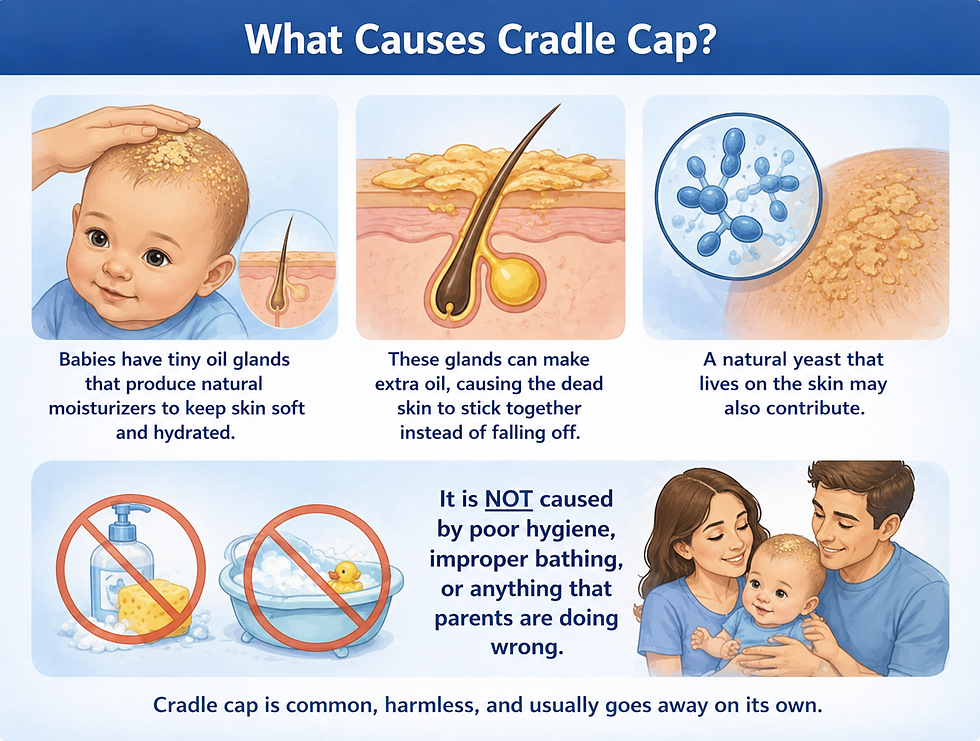
The exact cause of cradle cap is not fully understood, but there are some things that may play a role. Babies have tiny oil glands in their skin, which produce natural moisturizers to keep it soft and hydrated [1]. These glands can make extra oil, causing the dead skin to stick together instead of falling off [1]. A natural yeast that lives on the skin may also contribute [1]. It is NOT caused by poor hygiene, improper bathing, or anything that parents are doing wrong [1,3].
How Do I Know if My Child Has Cradle Cap?
You may notice some common symptoms:
You may notice some less common symptoms:
Who Is at Risk for Cradle Cap?
How Is Cradle Cap Diagnosed?
Doctors can diagnose cradle cap simply by looking at your baby’s skin and considering what it looks like and where it’s found. No bloodwork, skin biopsies, or other tests are usually needed for straightforward cases [1,3].
Treatment Options
The good news is that cradle cap will often go away on its own, and treatment is often unnecessary [1,2]. There are several common treatments that can be used, but there is limited high-quality evidence to show what works best, so it’s a good idea to discuss them with your doctor [1].
Common approach for mild cases:
Apply a small amount of mineral oil or petroleum jelly (Vaseline) to your baby’s scalp to soften the flakes. Let it sit for a few minutes (or even overnight) [2,3].
Use a soft brush (designed for babies) to gently brush away the loosened scales [2,3].
Be gentle, as scrubbing too hard can irritate your baby’s skin.
This can be repeated as needed, but just note that shampooing your baby’s head too much can cause dryness [2].
In more severe cases or if it does not improve, a doctor may discuss with you:
Prevention
Cradle cap cannot usually be prevented [1]. Gentle scalp care, such as regular washing and avoiding buildup, may help manage it [2].
When to Seek Medical Advice
Watch out for any of the following red flags that may be a sign that it is not just cradle cap, and see a healthcare provider if you notice:
Your baby seems more irritable and uncomfortable. Cradle cap should not bother your baby [1,3].
The scales are dry, rather than greasy [3].
Thick, well-defined red or purple patches with a silvery scale [3].
The rash is getting worse or not improving [3].
Signs of infection (oozing, the redness is spreading, crusting) [3].
Any other unusual symptoms, or if you are concerned at all.
Frequently Asked Questions (FAQs)
Will cradle cap go away on its own?
Did I do something to cause this?
No, it is very common and not caused by something that you did or didn’t do [1].
Can it be prevented?
No, it generally cannot be prevented. However, gentle scalp care may help manage it [2].
Does it bother my baby?
Cradle cap is generally NOT itchy or painful, and babies are not bothered by it [1].
Can I pick the flakes off?
No, picking the flakes off can irritate the skin. It is best to gently loosen them instead [2].
Sources:
Victoire A, Magin P, Coughlan J, van Driel ML. Interventions for infantile seborrhoeic dermatitis (including cradle cap). Cochrane Database Syst Rev. 2019;3:CD011380. doi:10.1002/14651858.CD011380.pub2
Canadian Paediatric Society. Your baby’s skin. Caring for Kids. https://caringforkids.cps.ca/handouts/pregnancy-and-babies/your-babys-skin. Accessed April 2026.
O’Connor NR, McLaughlin MR, Ham P. Newborn skin: part I. Common rashes. Am Fam Physician. 2008;77(1):47-52.
Are you still confused or do you still have questions?
Medical Disclaimer: HealthDecoded content is for education only and does not replace professional medical advice. Always seek guidance from a qualified healthcare provider.
© HealthDecoded. All content is original and protected by copyright. Reproduction or distribution without permission is not permitted.